

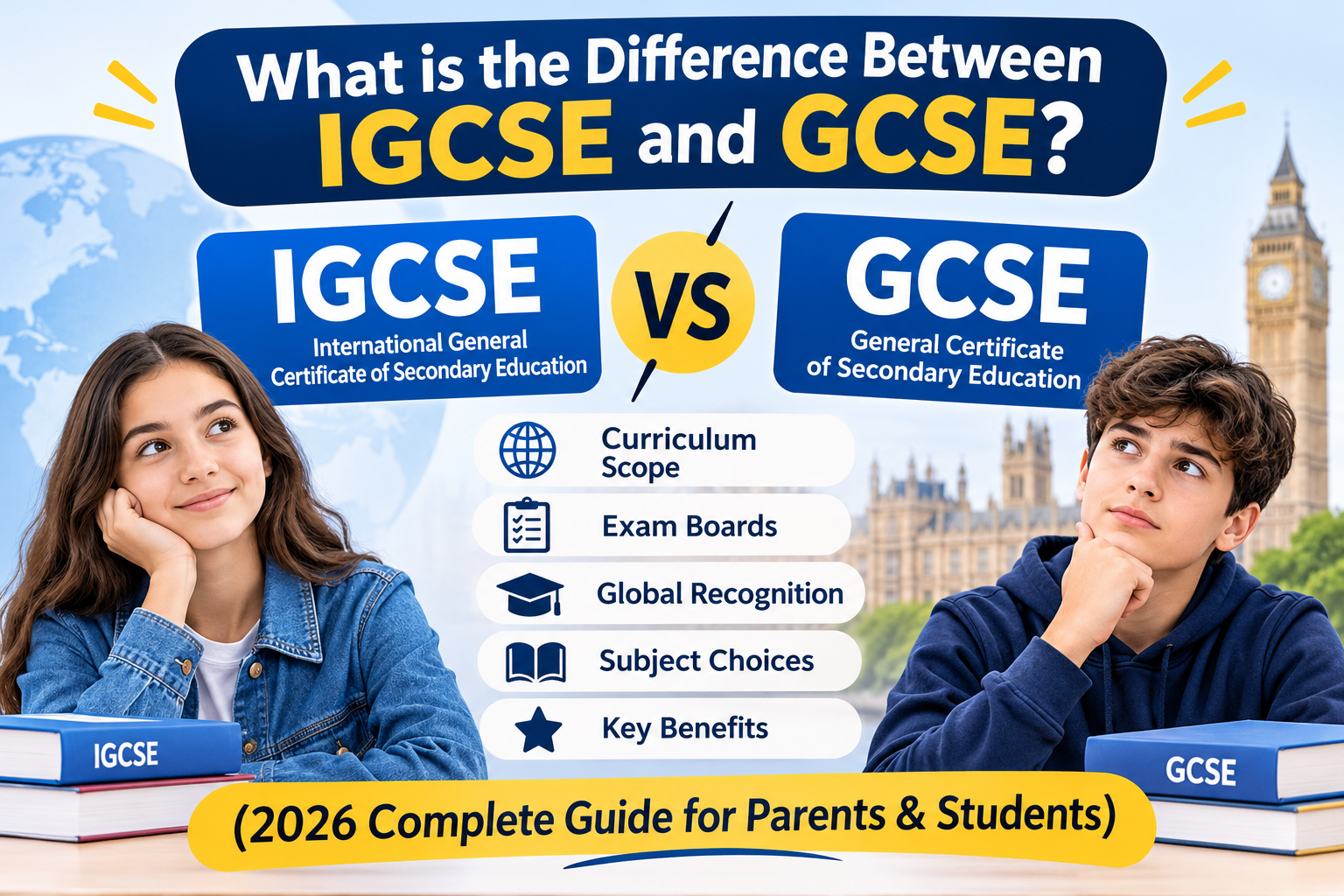

Selecting the right pre-university secondary qualification is a critical milestone for students aged 14 to 16. As high schoolers prepare for higher education, parents and students frequently compare two of the most prestigious secondary credentials worldwide: the GCSE (General Certificate of Secondary Education) and the IGCSE (International General Certificate of Secondary Education).
While both are recognized Level 2 secondary school qualifications designed for 16-year-olds—and both are considered fully equivalent by top UK universities, Malaysian institutions, and global employers—they differ significantly in their curriculum scope, exam boards, assessment flexibility, and subject nuances.
Whether you are studying at an international school in Malaysia (such as in Kuala Lumpur, Mont Kiara, or Subang Jaya) or evaluating pathways for university abroad, this complete comparison guide will help you choose the best fit for your academic goals.
At a Glance: IGCSE vs GCSE Comparison Table
| Feature | GCSE (General Certificate of Secondary Education) | IGCSE (International General Certificate of Secondary Education) |
|---|---|---|
| Primary Target Audience | Students studying in UK state and private schools | International school students in 150+ countries and UK independent schools |
| Curriculum Context | Tailored to the British national context (e.g., compulsory UK English Literature and Shakespeare) | Globalised curriculum context with international examples suitable for multicultural learners |
| Primary Exam Boards | AQA, Pearson Edexcel, OCR, WJEC (regulated by Ofqual in the UK) | Cambridge Assessment International Education (CAIE) and Pearson Edexcel International |
| Grading Scale | Strict 9-to-1 numerical grading scale (9 being the highest) | Flexible: Traditional A*-to-G scale or 9-to-1 scale, depending on the exam board or school preference |
| Assessment Structure | Heavily final exam-based, with minimal coursework following UK linear reforms | Flexible options: Tiered papers (Core/Extended), coursework options, or pure exam pathways |
| Global Recognition | Primarily recognised across the UK for A-Levels, BTECs, and UK university entry | Widely recognised across Malaysia, the UK, the US, Canada, Australia, and worldwide |
Key Differences Between IGCSE and GCSE Explained
1. Curriculum Scope & Target Audience
GCSE: Built around the UK national curriculum. The content uses localized British historical, geographical, and literary contexts. For instance, English literature modules often mandate specific British classical texts.
IGCSE: Designed specifically for international students across more than 150 countries. The scenarios, literary options, and scientific contexts are broadened so students from non-UK backgrounds can engage with questions fairly without cultural bias.
2. Exam Boards & Regulatory Bodies
GCSE Exam Boards: Regulated by Ofqual in the UK and set by UK-based exam boards including AQA, Pearson Edexcel, OCR, and WJEC.
IGCSE Exam Boards: Developed and managed globally primarily by Cambridge Assessment International Education (CAIE) and Pearson Edexcel International.
3. Assessment Flexibility & Tiering
GCSE: Following recent educational reforms in the UK, GCSEs are almost exclusively linear, meaning students take all their written exams at the end of the two-year course with very limited coursework.
IGCSE: Offers greater assessment flexibility. Many subjects provide tiered entry options (such as Core vs. Extended in Cambridge or Foundation vs. Higher in Edexcel). This allows students of varying academic starting points to sit for papers that match their confidence level.
4. Grading Systems (9-to-1 vs A*-to-G)
GCSE: Uses the standardized 9-1 numerical scale (where 9 represents exceptional performance above an A*, Grade 4 is a standard pass, and Grade 5 is a strong pass).
IGCSE: Depending on the school and exam board chosen, IGCSE offers either the traditional A*-G grading scale or the revised 9-1 scale, giving international schools flexibility to align with their regional preference.
Subject & Difficulty Nuances: Is IGCSE Harder Than GCSE?
When analyzing student feedback, exam mark schemes, and teacher assessments, difficulty varies by subject:
IGCSE Mathematics (Perceived as Harder): IGCSE Maths (especially CAIE and Edexcel Extended) is widely considered slightly more demanding than standard GCSE Maths. It incorporates advanced topics such as basic calculus, differentiation, vectors, and complex functions that are traditionally introduced later at the pre-university level.
IGCSE English Language & Literature (Perceived as More Accessible): Many students find IGCSE English more straightforward than UK GCSE English because it focuses more heavily on analytical comprehension, unseen passages, and skill-based writing, rather than requiring deep memorization of UK-specific historical texts.
IGCSE in Malaysia: Why Parents & International Students Choose It
In Malaysia, the IGCSE has become the gold standard pre-university foundation for students in private and international schools (across Kuala Lumpur, Subang Jaya, Mont Kiara, and Penang).
Why IGCSE is the Preferred Choice in Malaysia:
Direct Alternative to SPM: IGCSE provides an English-medium, globally accredited alternative to SPM (Sijil Pelajaran Malaysia), paving a direct pathway into Foundation, A-Levels, IBDP, or CIMP programs.
Global & Local University Acceptance: All major Malaysian private universities (such as Sunway, Taylor’s, Monash Malaysia, IMU, and Heriot-Watt) as well as top UK, Australian, and US universities fully accept IGCSE results.
Flexible Subject Combinations: Students can customize their subject choices (Sciences, Business, Humanities, Languages) to align directly with their intended university degree pathway.
Frequently Asked Questions
Is IGCSE harder than GCSE?
Not necessarily overall, but it depends on the subject. IGCSE Mathematics is often considered harder because it covers advanced topics like calculus and differentiation. However, IGCSE English is frequently viewed as more accessible for international students because it focuses on practical comprehension and analysis rather than UK-specific literary context.
Are IGCSE and GCSE the same?
They are academically equivalent Level 2 qualifications designed for 16-year-olds, and both are accepted equally by universities worldwide. However, they are not identical: GCSE is tailored for UK national schools using Ofqual exam boards and a 9-1 grading system, while IGCSE is tailored for international students worldwide using CAIE or Edexcel with global contexts and flexible grading (9-1 or A*-G).
What is the IGCSE equivalent in Malaysia?
The national Malaysian equivalent to IGCSE is the SPM (Sijil Pelajaran Malaysia). Both are 10th-grade secondary school exit qualifications taken at age 16. While SPM is taught in Bahasa Malaysia following the national syllabus, IGCSE is taught in English and follows an international curriculum.
Is IGCSE harder than O Levels?
IGCSE and Cambridge O Levels are equivalent qualifications administered at the same academic level. However, IGCSE is generally considered more modern and flexible, offering a broader range of coursework options, oral exams, and tiered papers (Core vs. Extended), whereas traditional O Levels rely almost entirely on final written examinations.
Do universities in Malaysia and the UK prefer GCSE or IGCSE?
Universities treat GCSE and IGCSE as 100% equal. Whether you are applying to UK Russell Group universities or top private universities in Malaysia, admission officers view Grade 7/A in IGCSE identically to Grade 7/A in GCSE.
Master Your IGCSE & GCSE Exams with ACE Education Malaysia
Navigating the syllabus differences, past paper mark schemes, and tiered exam options in IGCSE or GCSE can feel overwhelming. Whether your child needs help mastering IGCSE Extended Maths, Chemistry, Physics, Biology, or English, personalized tutoring makes all the difference.
At ACE Education, our expert subject tutors specialize in CAIE and Edexcel curricula to help students close learning gaps, master exam techniques, and score top A* grades.
Tailored 1-on-1 & Small Group Tutoring (In-Person in Klang Valley / Subang Jaya / Mont Kiara & Live Online)
Comprehensive Past-Paper Drills & Mark Scheme Mastery
Diagnostic Academic Assessments for Year 10 & Year 11 Students
